
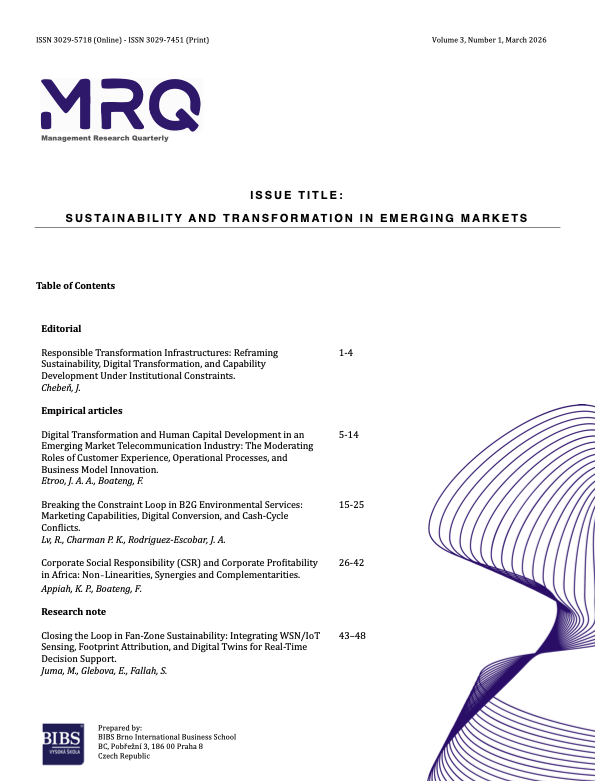
Breaking the Constraint Loop in B2G Environmental Services: Marketing Capabilities, Digital Conversion, and Cash-Cycle conflicts
DOI:
https://doi.org/10.63029/hmysj435Keywords:
environmental services, sustainability-oriented marketing, B2G procurement, marketing capabilities, digital conversion, value-based selling, ChinaAbstract
Environmental services increasingly operate in sustainability-critical B2G and B2B markets shaped by tender competition, high accountability, and long payment cycles. Yet little is known about how procurement rules, legitimacy barriers, and cash-cycle frictions affect marketing capability development in such settings. This study examines a regional environmental service provider in China through a mixed-method single-case design combining interviews, archival records, a client survey, expert validation. The findings reveal a constraint transmission mechanism in which procurement price pressure and delayed payments suppress discretionary investment, weakening digital conversion, customer management, and solution/value articulation capabilities. These deficits reduce differentiation and constrain cross-regional legitimacy transfer. The study contributes a constraint-sensitive marketing capability framework and offers implications for legitimacy transfer, enterprise customer development, and digital conversion.
References
Leonidou, L. C., Katsikeas, C. S., & Morgan, N. A. (2013). “Greening” the marketing mix: Do firms do it and does it pay off? Journal of the Academy of Marketing Science, 41, 151–170. https://doi.org/10.1007/s11747-012-0317-2 DOI: https://doi.org/10.1007/s11747-012-0317-2
Crittenden, V. L., Crittenden, W. F., Ferrell, L. K., Ferrell, O. C., & Pinney, C. C. (2011). Market-oriented sustainability: A conceptual framework and propositions. Journal of the Academy of Marketing Science, 39, 71–85. https://doi.org/10.1007/s11747-010-0217-2 DOI: https://doi.org/10.1007/s11747-010-0217-2
Day, G. S. (1994). The capabilities of market-driven organizations. Journal of Marketing, 58, 37–52. https://doi.org/10.1177/002224299405800404 DOI: https://doi.org/10.1177/002224299405800404
Kannan, P. K., & Li, H. (2017). Digital marketing: A framework, review and research agenda. International Journal of Research in Marketing, 34, 22–45. https://doi.org/10.1016/j.ijresmar.2016.11.006 DOI: https://doi.org/10.1016/j.ijresmar.2016.11.006
Homburg, C., & Wielgos, D. M. (2022). The value relevance of digital marketing capabilities to firm performance. Journal of the Academy of Marketing Science, 50, 666–688. https://doi.org/10.1007/s11747-021-00833-8 DOI: https://doi.org/10.1007/s11747-022-00858-7
Morgan, N. A., Slotegraaf, R. J., & Vorhies, D. W. (2009). Linking marketing capabilities with profit growth. International Journal of Research in Marketing, 26, 284–293. https://doi.org/10.1016/j.ijresmar.2009.06.005 DOI: https://doi.org/10.1016/j.ijresmar.2009.06.005
Vorhies, D. W., & Morgan, N. A. (2005). Benchmarking marketing capabilities for sustainable competitive advantage. Journal of Marketing, 69, 80–94. https://doi.org/10.1509/jmkg.69.1.80.55505 DOI: https://doi.org/10.1509/jmkg.69.1.80.55505
Morgan, R. M., & Hunt, S. D. (1994). The commitment-trust theory of relationship marketing. Journal of Marketing, 58, 20–38. https://doi.org/10.1177/002224299405800302 DOI: https://doi.org/10.1177/002224299405800302
Palmatier, R. W., Dant, R. P., Grewal, D., & Evans, K. R. (2006). Factors influencing the effectiveness of relationship marketing: A meta-analysis. Journal of Marketing, 70, 136–153. https://doi.org/10.1509/jmkg.70.4.136 DOI: https://doi.org/10.1509/jmkg.70.4.136
Boyer, A. (2024). Navigating complexity: Interdisciplinary approaches to sustainable supply chain management. Management Research Quarterly, 1, 1–3. https://doi.org/10.63029/78v84162 DOI: https://doi.org/10.63029/78v84162
Purvis, B., & Fernandez, D. B. (2024). Sustainability in global industrial shipping chains: A positivist perspective of international relations. Management Research Quarterly, 1, 12–22. https://doi.org/10.63029/6s5ee610 DOI: https://doi.org/10.63029/6s5ee610
Lissillour, R., & Silva, M. E. (2024). Going forward and beyond: On the track of a practice turn in supply chain sustainability studies. RAUSP Management Journal, 59, 138–153. https://doi.org/10.1108/RAUSP-09-2023-0181 DOI: https://doi.org/10.1108/RAUSP-09-2023-0181
Lissillour, R. (2024). Exposing power and inequality in sustainable supply chains: A critical research agenda for transformative change. Management Prospect, 41, 76–90. https://doi.org/10.3917/g2000.415.0058 DOI: https://doi.org/10.3917/g2000.415.0058
Vavrina, J., & Drdla, M. (2024). Governance of social attributes behind ESG concepts in business entities: An empirical evidence based on the benchmarking approach. Management Research Quarterly, 1, 33–39. https://doi.org/10.63029/67mqjk39 DOI: https://doi.org/10.63029/67mqjk39
Wang, J. (2024). Selective coupling in hybrid organization: Institutional logic contradiction in the context of ERP post-implementation. Management Research Quarterly, 1, 13–26. https://doi.org/10.63029/x78va191 DOI: https://doi.org/10.63029/x78va191
Weng, Y., Charman, K. P., & Reaksmey, V. (2025). Unlocking the growth of prefabricated construction in China: Policy-market synergy as a Strategic Lever. Management Research Quarterly, 2, 4–22. https://doi.org/10.63029/xjq49j12 DOI: https://doi.org/10.63029/xjq49j12
Suchman, M. C. (1995). Managing legitimacy: Strategic and institutional approaches. Academy of Management Review, 20, 571–610. https://doi.org/10.2307/258788 DOI: https://doi.org/10.2307/258788
Vargo, S. L., & Lusch, R. F. (2004). Evolving to a new dominant logic for marketing. Journal of Marketing, 68, 1–17. https://doi.org/10.1509/jmkg.68.1.1.24036 DOI: https://doi.org/10.1509/jmkg.68.1.1.24036
Teece, D. J. (2007). Explicating dynamic capabilities: The nature and microfoundations of (sustainable) enterprise performance. Strategic Management Journal, 28, 1319–1350. https://doi.org/10.1002/smj.640 DOI: https://doi.org/10.1002/smj.640
Kohli, A. K., & Jaworski, B. J. (1990). Market orientation: The construct, research propositions, and managerial implications. Journal of Marketing, 54, 1–18. https://doi.org/10.1177/002224299005400201 DOI: https://doi.org/10.1177/002224299005400201
Narver, J. C., & Slater, S. F. (1990). The effect of a market orientation on business profitability. Journal of Marketing, 54, 20–35. https://doi.org/10.1177/002224299005400403 DOI: https://doi.org/10.1177/002224299005400403
Terho, H., Haas, A., Eggert, A., & Ulaga, W. (2012). It is almost like taking the sales out of selling: Conceptualizing value-based selling in business markets. Industrial Marketing Management, 41, 174–185. https://doi.org/10.1016/j.indmarman.2011.11.011 DOI: https://doi.org/10.1016/j.indmarman.2011.11.011
Payne, A., & Frow, P. (2005). A strategic framework for customer relationship management. Journal of Marketing, 69, 167–176. https://doi.org/10.1509/jmkg.2005.69.4.167 DOI: https://doi.org/10.1509/jmkg.2005.69.4.167
Trainor, K. J., Andzulis, J. M., Rapp, A., & Agnihotri, R. (2014). Social media technology usage and customer relationship performance: A capabilities-based examination of social CRM. Journal of Business Research, 67, 1201–1208. https://doi.org/10.1016/j.jbusres.2013.05.002 DOI: https://doi.org/10.1016/j.jbusres.2013.05.002
Guechtouli, M., & Purvis, B. (2024). Social media for information sharing in an industrial setting: Evidence from the Chinese automotive industry. Management Research Quarterly, 1, 4–13. https://doi.org/10.63029/td1je276 DOI: https://doi.org/10.63029/td1je276
Desmarchelier, B. (2024). Exploring organizational learning in the era of emerging technologies. Management Research Quarterly, 1, 1–3. https://doi.org/10.63029/n1pprk28 DOI: https://doi.org/10.63029/n1pprk28
Yin, R. K. (2018). Case study research and applications: Design and methods (6th ed.). SAGE.
Ritter, T., & Pedersen, C. L. (2020). Digitization capability and the digitalization of business models in business-to-business firms: Past, present, and future. Industrial Marketing Management, 86, 180–190. https://doi.org/10.1016/j.indmarman.2019.11.019 DOI: https://doi.org/10.1016/j.indmarman.2019.11.019
Hoekman, B. (2022). Procurement policy and SME participation in public purchasing. Small Business Economics, 58, 1–17. https://doi.org/10.1007/s11187-020-00414-z DOI: https://doi.org/10.1007/s11187-020-00414-z
Tuli, K. R., Kohli, A. K., & Bharadwaj, S. G. (2007). Rethinking customer solutions: From product bundles to relational processes. Journal of Marketing, 71, 1–17. https://doi.org/10.1509/jmkg.71.3.001 DOI: https://doi.org/10.1509/jmkg.71.3.001
Ulaga, W., & Reinartz, W. J. (2011). Hybrid offerings: How manufacturing firms combine goods and services successfully. Journal of Marketing, 75, 5–23. https://doi.org/10.1509/jm.09.0395 DOI: https://doi.org/10.1509/jm.09.0395
Lissillour, R. (2025). Reframing sustainability learning through certification: A practice-perspective on supply chain management. Sustainability, 17, 5761. https://doi.org/10.3390/su17135761 DOI: https://doi.org/10.3390/su17135761
Vrontis, D., Shams, R., Kotabe, M., & Kumar, V. (2025). B2B marketing for people, planet and profit: Theoretical advancement and empirical insights. Industrial Marketing Management, 130, A1–A9. https://doi.org/10.1016/j.indmarman.2025.08.003 DOI: https://doi.org/10.1016/j.indmarman.2025.08.003
Bag, S., Srivastava, G., Gupta, S., Zhang, J. Z., & Kamble, S. (2023). Change adaptation capability, business-to-business marketing capability and firm performance: Integrating institutional theory and dynamic capability view. Industrial Marketing Management, 115, 470–483. https://doi.org/10.1016/j.indmarman.2023.11.003 DOI: https://doi.org/10.1016/j.indmarman.2023.11.003
Dayangan, C., & Aykol, B. (2024). Dynamic capabilities research in international marketing: A systematic literature review and direction for future research. International Marketing Review, 41, 1618–1672. https://doi.org/10.1108/IMR-08-2023-0168 DOI: https://doi.org/10.1108/IMR-08-2023-0168
Flynn, A. (2025). Research on SME involvement in public procurement: A review, critique and conceptual framework. Journal of Purchasing and Supply Management, 31, 101052. https://doi.org/10.1016/j.pursup.2025.101052 DOI: https://doi.org/10.1016/j.pursup.2025.101052
Kaya, O. (2024). The impact of late payments on SMEs’ access to finance: Evidence from credit rationing and loan terms. Economic Modelling, 141, 106896. https://doi.org/10.1016/j.econmod.2024.106896 DOI: https://doi.org/10.1016/j.econmod.2024.106896
Khan, H., Gupta, S., Kumar, V., & Kumar, B. (2023). Managing climate change risks and creating stakeholders’ value via sustainability-focused B2B brand strategies. Industrial Marketing Management, 115, 198–213. https://doi.org/10.1016/j.indmarman.2023.09.017 DOI: https://doi.org/10.1016/j.indmarman.2023.09.017
Rahman, M. S., Bag, S., Gupta, S., & Sivarajah, U. (2023). Technology readiness of B2B firms and AI-based customer relationship management capability for enhancing social sustainability performance. Journal of Business Research, 156, 113525. https://doi.org/10.1016/j.jbusres.2022.113525 DOI: https://doi.org/10.1016/j.jbusres.2022.113525
Ravat, L., Hemonnet-Goujot, A., & Hollet-Haudebert, S. (2024). Exploring how to develop data-driven innovation capability of marketing within B2B firms: Toward a capability model and process-oriented approach. Industrial Marketing Management, 117, 102–116. https://doi.org/10.1016/j.indmarman.2023.12.015 DOI: https://doi.org/10.1016/j.indmarman.2023.12.015
Rivero-Gutierrez, L., Cabanelas, P., Diez-Martin, F., & Blanco-Gonzalez, A. (2024). How can companies boost legitimacy in international markets? A dynamic marketing capabilities approach. International Marketing Review, 41, 273–301. https://doi.org/10.1108/IMR-09-2022-0215 DOI: https://doi.org/10.1108/IMR-09-2022-0215
Sairanen, M., & Aarikka-Stenroos, L. (2024). Low-carbon business models: Review and typology. Industrial Marketing Management, 123, 222–250. https://doi.org/10.1016/j.indmarman.2024.10.001 DOI: https://doi.org/10.1016/j.indmarman.2024.10.001
Bajwa, F. A., Fu, J., Bajwa, I. A., Rehman, M., & Abbas, K. (2025). Digital financial inclusion and its dual impact on economic and environmental outcomes in ASEAN countries. Data Science in Finance and Economics, 5, 53–75. https://doi.org/10.3934/DSFE.2025004 DOI: https://doi.org/10.3934/DSFE.2025004
Li, Z., Chen, Z., & Huang, Z. (2026). Modelling the data-generating mechanism of China’s commodity market by identifying hidden information flow regimes. Financial Innovation, 12, 28. https://doi.org/10.1186/s40854-025-00804-w DOI: https://doi.org/10.1186/s40854-025-00804-w
Downloads
Published
Issue
Section
Categories
License
Copyright (c) 2026 BIBS Brno International Business School

This work is licensed under a Creative Commons Attribution-NonCommercial-NoDerivatives 4.0 International License.
How to Cite