
Archives
-
Resilience in Practice
Vol. 2 No. 2 (2025)This issue maps how organizations renew practice under institutional flux and technological turbulence. Weng, Charman, and Reaksmey show that China’s prefabricated construction advances when policy incentives synchronize with market responsiveness and digital tools (BIM, modular design), offering a blueprint for sustainability transitions. Nyamekye and Kwarteng reconceptualize dynamic capabilities in Ghanaian law firms as mechanisms of continuity, identifying interlinked factors—from client portfolios to collaborative culture—that stabilize performance over time. Bahadori and Ramjawan translate Bourdieu’s theory of practice into a power-aware toolkit (field, habitus, capitals), extending it with gender capital and boundary spanning, and calling for practice-based participatory action research. Zhang and Gao review An Introduction to Computational Advertising, linking algorithmic advertising to fairness, interpretability, and responsible AI agendas in platform ecosystems. An editorial frames these contributions around one argument: resilience emerges from aligning capabilities with policy signals, market logics, and reflexive methods.
-

Complexities in Business Environments
Vol. 1 No. 1 (2024)This inaugural issue of Management Research Quarterly features a collection of research articles that delve into the complex dynamics of business practices across diverse sectors. It highlights how businesses in various global contexts, particularly in Africa and Asia, navigate complex institutional frameworks, innovation cultures, and familial value systems. The issue emphasizes the importance of indigenous scholarship and its role in challenging and expanding global management knowledge beyond dominant Western paradigms. Articles explore themes ranging from Total Quality Management in healthcare to the impact of familial values on business practices, showcasing the rich diversity of management research and its practical implications.
-
Responsible Research Across Emerging Infrastructures
Vol. 2 No. 4 (2025)This issue brings together contributions that examine responsibility, credibility, and value creation across a diverse set of contemporary management contexts. From the design of responsible research itself to virtual commerce, banking governance, journal infrastructures, and cognitive computational advertising, the articles share a common concern with how socio-technical systems are shaped, interpreted, and governed. Taken together, they position management research as a field that must not only explain organizational phenomena, but also clarify the conditions under which knowledge can be used responsibly in practice.
-

Global Frameworks and Local Practices
Vol. 1 No. 3 (2024)This issue dedicated to exploring sustainable supply chains through an interdisciplinary lens, incorporating theories from International Relations (IR) to better understand the complexities of global logistics in an era marked by significant geopolitical shifts. As the demand for sustainable business practices grows, this issue highlights innovative research that integrates environmental, social, and economic considerations into supply chain management. The contribu‐ tions within this issue apply a mix of realist and liberalist IR perspectives to dissect the dynamics of global and local supply chain strategies, focusing on industries such as shipping and the growing influence of artificial intelligence in supply chain practices. By merging theoretical approaches from IR with practical supply chain issues, the articles offer novel insights into how businesses and poli‐ cymakers can navigate the challenges of sustainability amid global uncertainties. This issue not only advances academic discourse but also proposes actionable frameworks for practitioners aiming to implement robust and responsible supply chain strategies. The overarching message advocates for a concerted effort to align international cooperation with corporate governance to foster sustain‐ able and resilient supply chains worldwide.
-
From Adoption to Value: The Organizational Challenge of AI and Digital Transformation
Vol. 3 No. 2 (2026)This issue, From Adoption to Value: The Organizational Challenge of AI and Digital Transformation, examines why the adoption of digital technologies and artificial intelligence does not automatically translate into sustained organizational value. Across studies of generative AI, digital technology integration, AI-enabled efficiency, and implementation in the sports industry, the contributions highlight the importance of moving beyond adoption metrics toward questions of integration, user experience, organizational complementarity, implementation capability, and governance. Taken together, the issue shows that value creation depends not only on whether technologies are adopted, but on how deeply they are embedded in work practices, how effectively local efficiency gains are converted into broader outcomes, and how organizations manage the human, structural, and institutional conditions that shape implementation.
-
Leading Through Uncertainty
Vol. 2 No. 1 (2025)This issue explores how organizations cope with uncertainty, complexity, and technological transformation across diverse socio-economic contexts. The issue includes empirical and critical contributions on psychological empowerment in public institutions, leadership and telework performance in fragile states, power dynamics in AI supervision, and epistemic hierarchies in scholarly publishing. Together, these articles promote context-sensitive, interdisciplinary, and inclusive perspectives on contemporary organizational challenges.
-
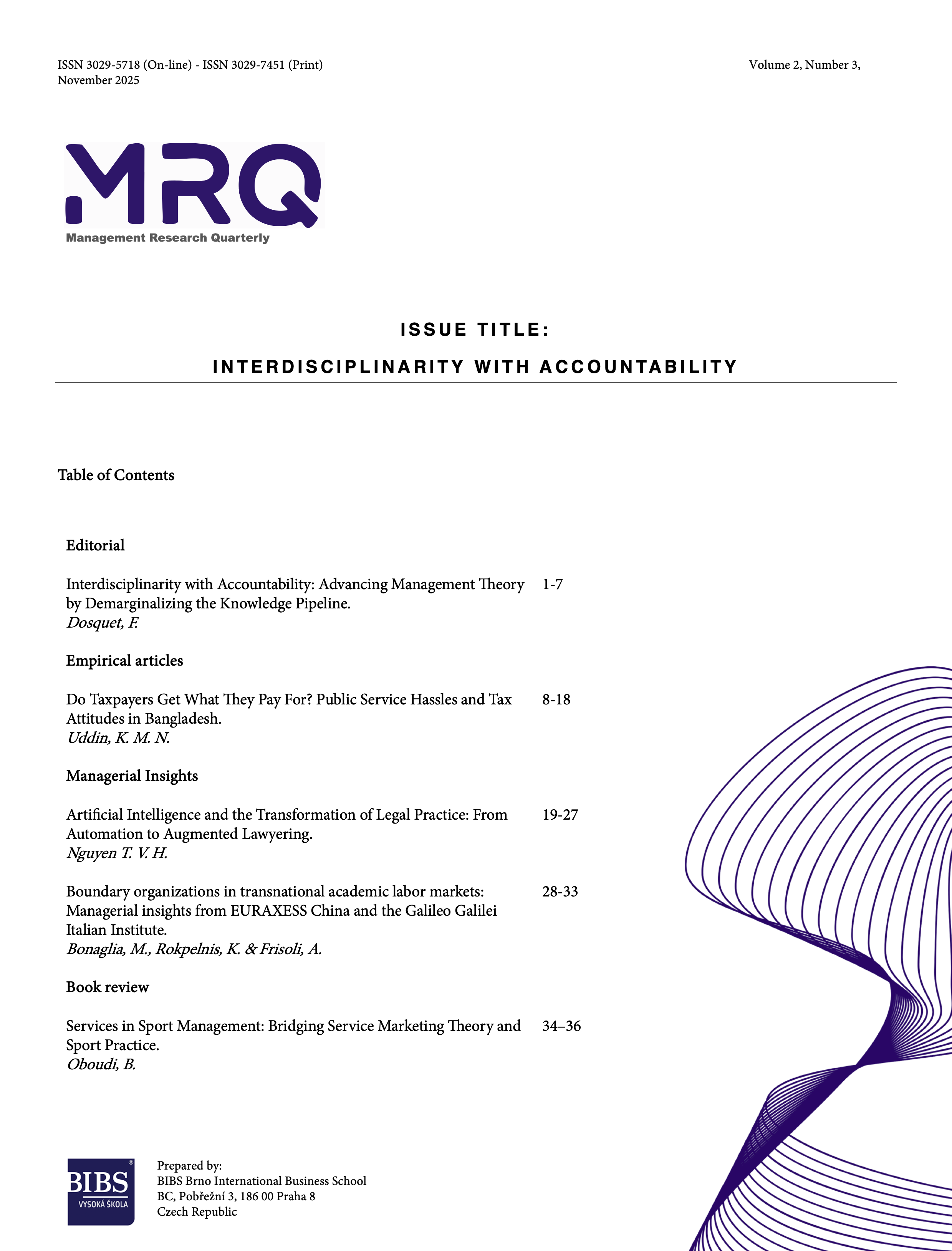
Accountable Interdisciplinarity Across Boundaries: Tax Justice, Academic Mobility, AI, and Sport Services
Vol. 2 No. 3 (2025)This issue advances accountable interdisciplinarity as an editorial and scholarly program: not only combining lenses, but widening the epistemic community from which management theory is built and designing publication infrastructures that make rigorous integration and genuine inclusion more likely. Across four contributions, the issue foregrounds boundary work: the mechanisms, objects, and governance arrangements that allow ideas, practices, and responsibilities to travel across institutional, professional, and societal divides without losing rigor.
Uddin’s empirical study shows how taxpayers’ lived encounters with tax administration and core public services shape perceived fairness and acceptance of taxation, documenting concrete “hassles” and their implications for tax justice and morale in a lower-middle-income context. Bonaglia and Rokpelnis reframe EURAXESS China and the Galileo Galilei Italian Institute as boundary organizations that translate shifting EU–China cooperation conditions into workable institutional routines and individual career pathways, offering actionable design logic for university leaders and research managers under de-risking and research-security pressures. Nguyen analyzes how AI is reconfiguring legal work toward “augmented lawyering,” emphasizing human–machine collaboration grounded in professional values, ethics, and organizational adaptation inside law firms. The issue closes with Oboudi’s review of Glebova’s Services in Sport Management, highlighting a structured bridge from foundational service theories to applied sport domains while calling for broader empirical and non-Western extensions.
-

Organizational Learning in the Era of Emerging Technologies
Vol. 1 No. 2 (2024)This second issue of Management Research Quarterly explores the dynamics of organizational learning within technology management contexts. It emphasizes the impact of employee behaviors, leadership, and technological integration on organizational performance and resilience. The contributions underscore the importance of identifying the root causes of emerging challenges and leveraging transformational leadership to enhance organizational adaptability. Additionally, the issue highlights the evolving role of social media platforms and artificial intelligence in reshaping organizational learning processes. These insights collectively demonstrate the continuing importance of organizational learning, particularly in the face of emerging technologies that offer both opportunities and challenges for modern organizations.
-
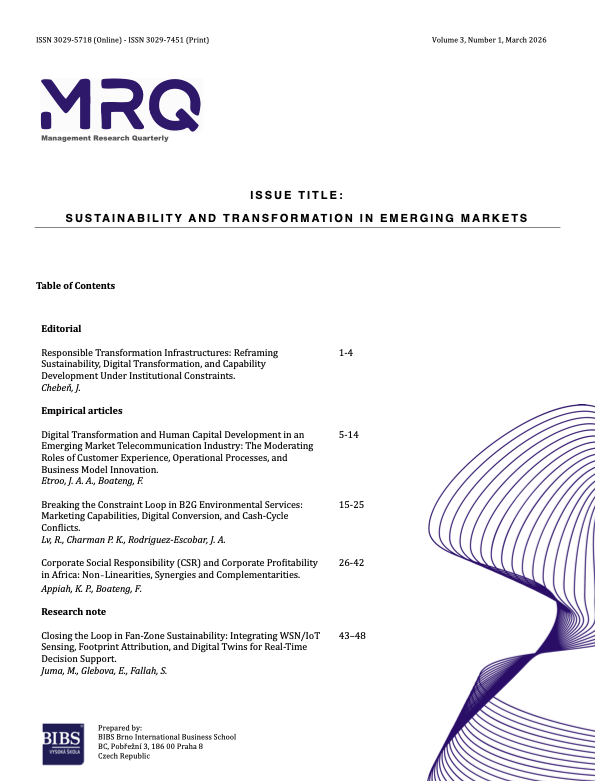
Sustainability and Transformation in Emerging Markets
Vol. 3 No. 1 (2026)This issue presents five articles exploring the intersection of sustainability, digital transformation, corporate responsibility, and organizational behavior in emerging and institutionally complex markets. The contributions examine how environmental services, CSR initiatives, digital adoption, and leadership behaviors influence firm performance, employee development, and stakeholder engagement. Empirical and conceptual studies demonstrate non-linear effects, capability contingencies, and constraint-sensitive strategies that guide responsible transformation. Collectively, these articles offer actionable insights for managers, policymakers, and scholars seeking to align organizational capabilities with sustainability, innovation, and human capital development under institutional and operational constraints.
-

Management Innovation and Sustainability: Local Challenges, Global Insights
Vol. 1 No. 4 (2024)This issue explores the dynamic interplay between sustainability, innovation, and cultural ethics in management. The issue features four diverse contributions that address pressing challenges in management, including the integration of gender-sensitive leadership, the balance of cultural preservation and economic sustainability in ethnic minority settlements, the impact of green human resource management practices on environmental performance in developing countries, and the reconfiguration of business ethics from a Chinese perspective. Together, these articles exemplify the importance of interdisciplinary approaches and contextualized solutions in advancing global management research. By drawing on case studies, empirical analyses, and theoretical frameworks, this issue provides actionable insights for scholars, practitioners, and policymakers seeking to foster sustainable and inclusive management practices. The editorial highlights the shared themes across the contributions and reflects on their implications for the evolving landscape of management in a rapidly transforming world.