
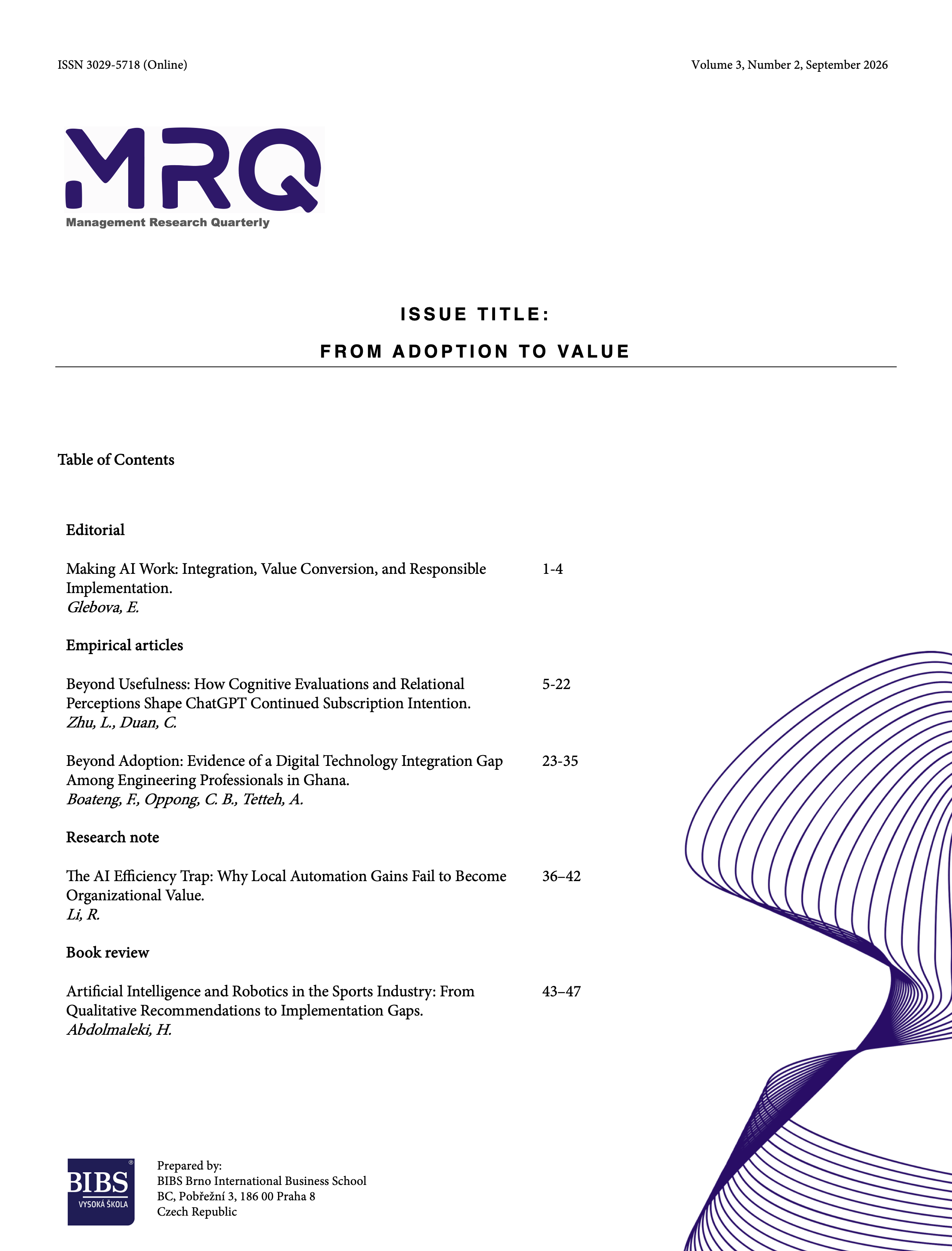
Making AI Work: Integration, Value Conversion, and Responsible Implementation
DOI:
https://doi.org/10.63029/gcb1aw45Keywords:
artificial intelligence, digital transformation, technology implementation, post-adoption, technology integration, organizational value, human--AI interaction, responsible AI, governance, value conversionAbstract
This editorial argues that the central managerial challenge is shifting from technology adoption to post-adoption implementation and value creation. The issue highlights a sequence of interrelated challenges: sustaining user commitment, embedding technologies in professional practices, converting local efficiency gains into organizational value, and ensuring that implementation remains responsible, legitimate, and governable. The papers show that adoption does not necessarily imply integration, that technical or task-level performance does not automatically translate into end-to-end organizational outcomes, and that value creation is shaped by organizational capabilities, human-AI relationships, governance arrangements, and power relations. The editorial suggests an integrative post-adoption perspective in which continued engagement, work-practice integration, organizational value conversion, and responsible implementation represent distinct but interconnected dimensions of digital transformation.
References
Abdolmaleki, H. (2026). Artificial intelligence and robotics in the sports industry: From qualitative recommendations to implementation gaps. Management Research Quarterly, 3(2), 43–47. https://doi.org/10.63029/d56x7t06 DOI: https://doi.org/10.63029/d56x7t06
Boateng, F., Oppong, C. B., & Tetteh, A. (2026). Beyond adoption: Evidence of a digital technology integration gap among engineering professionals in Ghana. Management Research Quarterly, 3(2), 23–35. https://doi.org/10.63029/h9413w11 DOI: https://doi.org/10.63029/h9413w11
Chapuis, V., & Guégan, D. (2024). Empowering the exercise of responsibility in the design, implementation and use of AI-based systems. Management Research Quarterly, 1(3), 23–32. https://doi.org/10.63029/jrgvn456 DOI: https://doi.org/10.63029/jrgvn456
Chebeň, J. (2026). Responsible transformation infrastructures: Reframing sustainability, digital transformation, and capability development under institutional constraints. Management Research Quarterly, 3(1), 1–4. https://doi.org/10.63029/h4amsv88 DOI: https://doi.org/10.63029/h4amsv88
Juma, M., Glebova, E., & Fallah, S. (2026). Closing the loop in fan-zone sustainability: Integrating WSN/IoT sensing, footprint attribution, and digital twins for real-time decision support. Management Research Quarterly, 3(1), 43–48. https://doi.org/10.63029/7g8xd643 DOI: https://doi.org/10.63029/7g8xd643
Li, R. (2026). The AI efficiency trap: Why local automation gains fail to become organizational value. Management Research Quarterly, 3(2), 36–42. https://doi.org/10.63029/tz21n342 DOI: https://doi.org/10.63029/tz21n342
Lissillour, R., & Monod, E. (2024). The illusion of transparency: Examining power dynamics in AI implementation strategies. Revue Internationale de Psychosociologie et de Gestion des Comportements Organisationnels, 30(80), 79–114. https://doi.org/10.3917/rips1.080.0079 DOI: https://doi.org/10.3917/rips1.080.0079
Lissillour, R., & Sahut, J.-M. (2026). What future for AI chatbots in banking: From current challenges to mirages? Information Technology & People, 39(5), 2027–2062. https://doi.org/10.1108/ITP-01-2025-0008 DOI: https://doi.org/10.1108/ITP-01-2025-0008
Monod, E. (2025). Robots as managers? Organizational justice, power asymmetries, and the future of AI supervision. Management Research Quarterly, 2(1), 41–49. https://doi.org/10.63029/rqg5z883 DOI: https://doi.org/10.63029/rqg5z883
Monod, E., Lissillour, R., & Joyce, E. (2023). AI implementation issues. In E. Monod & Y. Jiang (Eds.), Digital transformation: Organizational challenges and management transformation methods (pp. 49–69). Emerald Publishing Limited. DOI: https://doi.org/10.1108/979-8-88730-206-520251008
Nguyen, T. V. H. (2026). Artificial intelligence and the transformation of legal practice: From automation to augmented lawyering. Management Research Quarterly, 2(3), 19–27. https://doi.org/10.63029/t39w1n65 DOI: https://doi.org/10.63029/t39w1n65
Sahut, J.-M., Braune, É., & Lissillour, R. (2023). A problematization of artificial intelligence ethics: Deliberative democracy versus agonistic pluralism. Management & Prospective, 40(6), 186–199. https://doi.org/10.3917/g2000.406.0186 DOI: https://doi.org/10.3917/g2000.406.0200
Wang, J. (2024). Selective coupling in hybrid organization: Institutional logic contradiction in the context of ERP post-implementation. Management Research Quarterly, 1(1), 13–26. https://doi.org/10.63029/x78va191 DOI: https://doi.org/10.63029/x78va191
Zhu, L., & Duan, C. (2026). Beyond usefulness: How cognitive evaluations and relational perceptions shape ChatGPT continued subscription intention. Management Research Quarterly, 3(2), 5–22. https://doi.org/10.63029/1g979a20 DOI: https://doi.org/10.63029/1g979a20
Downloads
Published
Issue
Section
Categories
License
Copyright (c) 2026 BIBS Brno International Business School

This work is licensed under a Creative Commons Attribution-NonCommercial-NoDerivatives 4.0 International License.
How to Cite